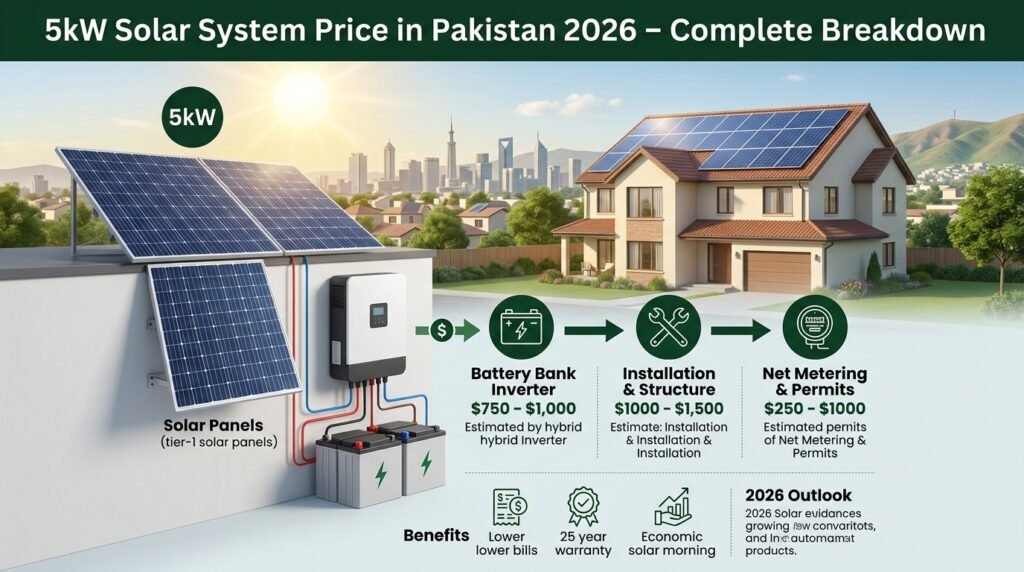
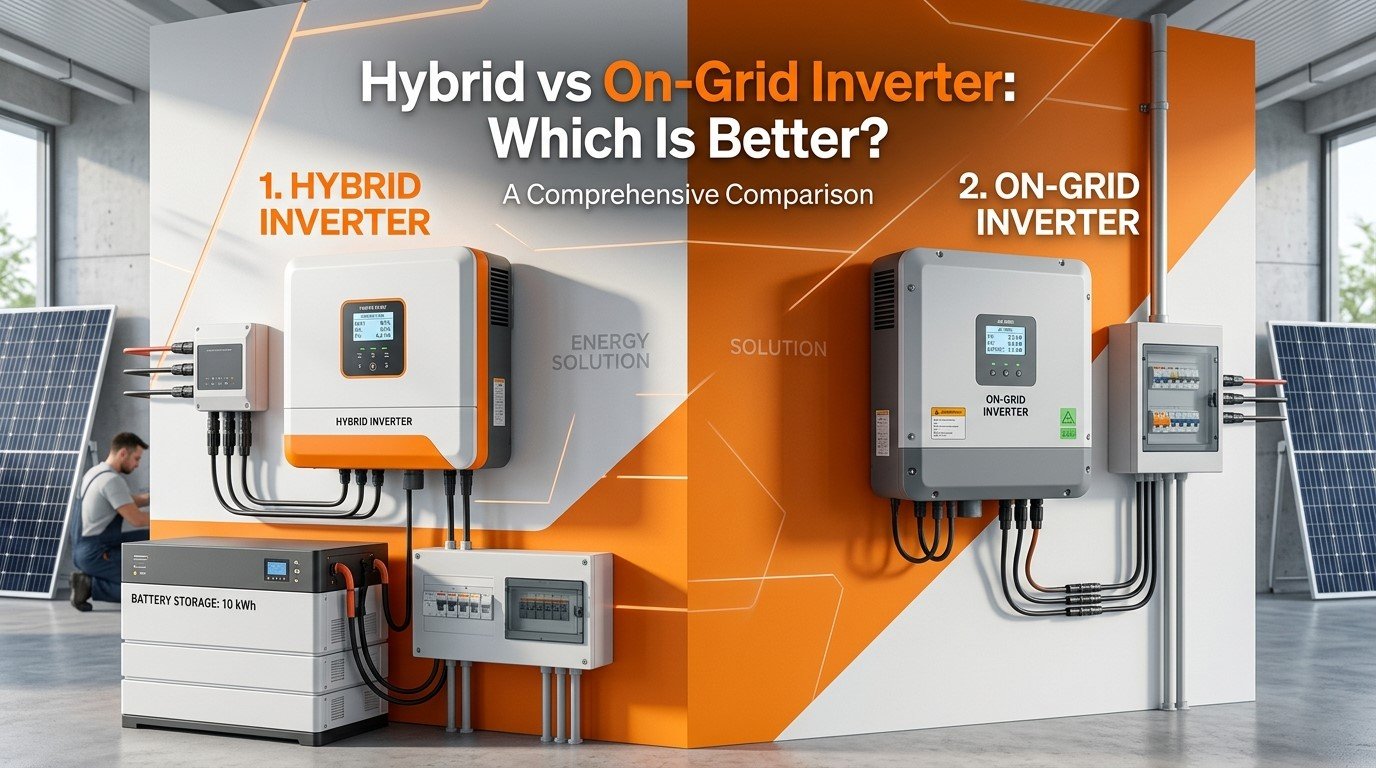
Choosing between a hybrid vs on-grid inverter in Pakistan is one of the most important decisions when installing a solar power system. With electricity costs, changing solar export policies, and the need for reliable backup power influencing homeowners’ decisions, selecting the right solar inverter can significantly affect your electricity savings and long-term investment.
Both hybrid and on-grid solar inverters convert the electricity generated by solar panels into usable power for household appliances. However, they differ in battery compatibility, backup functionality, installation cost, energy management, and how they handle surplus solar electricity.
An on-grid solar inverter is generally suitable for households that want to reduce electricity bills without investing in batteries. A hybrid solar inverter is designed to manage solar panels, the electricity grid, and compatible battery storage, making it a useful option for households that also need backup power during load-shedding.
But which inverter is better for Pakistan in 2026? The answer depends on your electricity consumption, frequency of power outages, budget, rooftop solar capacity, and the financial value of exported electricity.
In this comprehensive guide, we will explain the difference between hybrid and on-grid inverters, compare their prices and features, discuss their advantages and disadvantages, and help you choose the best solar inverter for your home or business in Pakistan.
Hybrid vs On-Grid Inverter: Quick Comparison
Before exploring the technical differences, let’s compare hybrid and on-grid solar inverters based on the factors that matter most to Pakistani solar buyers.
| Feature | Hybrid Solar Inverter | On-Grid Solar Inverter |
|---|---|---|
| Main purpose | Solar generation, grid management, and battery integration | Solar generation and grid-connected operation |
| Battery compatibility | Yes, for supported models | Generally no direct battery support |
| Backup during load-shedding | Possible with suitable batteries and backup configuration | Normally unavailable during grid outages |
| Initial inverter cost | Generally higher | Often lower |
| Battery installation | Optional, depending on the model and requirements | Not normally supported directly |
| Solar electricity consumption | Supports household loads | Supports household loads |
| Surplus electricity export | Possible with compatible equipment and approved arrangements | Possible with compatible equipment and approved arrangements |
| Energy storage | Can store solar energy in compatible batteries | Does not normally store energy |
| Installation complexity | May be more complex | Usually simpler |
| Best for | Homes needing flexibility and backup power | Homes focused on lower upfront cost and daytime savings |
The main difference is that a hybrid inverter can manage battery storage, while a conventional on-grid inverter is primarily designed to operate with the utility grid.
For homeowners who need backup electricity during load-shedding, a hybrid inverter is usually the more suitable option. For households that have reliable grid access and want a lower-cost solar installation, an on-grid inverter can be the better financial choice.
What Is a Hybrid Solar Inverter?
A hybrid solar inverter is a device that manages electricity from solar panels, the utility grid, and compatible batteries. It converts the direct current produced by solar panels into alternating current for household appliances while coordinating energy flow between the available sources.
Unlike a conventional on-grid inverter, a hybrid solar inverter can support battery charging and discharging when the model includes the required functionality.
Depending on its configuration, a hybrid inverter may prioritize solar power for household consumption, charge batteries using surplus solar electricity, draw electricity from the grid when needed, and provide backup power during a grid outage.
For Pakistani households, these features can be particularly useful in areas where load-shedding interrupts the electricity supply.
How Does a Hybrid Solar Inverter Work?
A hybrid solar inverter manages electricity through several operating modes.
1. Solar power for household appliances
During daylight hours, solar panels generate electricity. The inverter directs available solar power to household appliances, reducing the amount of electricity needed from the grid.
2. Battery charging
When solar generation exceeds the electricity required by household loads, the inverter can use the surplus to charge a compatible battery, provided the system is configured to do so.
3. Battery power during outages
When the grid supply fails, a properly configured hybrid inverter can supply designated backup circuits using available solar energy and battery storage.
4. Grid electricity when required
When solar generation and stored energy are insufficient, the system can draw electricity from the grid if it remains available and the operating configuration allows it.
The exact sequence of these operations depends on the inverter’s settings and capabilities.
Advantages of a Hybrid Solar Inverter
A hybrid solar inverter offers several benefits for residential and commercial solar installations in Pakistan.
- Backup power during load-shedding: Compatible batteries can supply electricity to selected appliances during outages.
- Battery integration: The system can store solar energy for use after sunset or during power interruptions.
- Flexible energy management: Users can configure supported operating modes to manage solar generation, grid electricity, and battery charging.
- Potentially higher self-consumption: Stored solar electricity can reduce the need to purchase grid electricity during periods without sunlight.
- Future expansion options: Some models support battery installation at a later date, subject to compatibility and manufacturer requirements.
- Monitoring and control: Many models provide applications or monitoring portals for tracking generation, consumption, and battery status.
These advantages make hybrid inverters worth considering for households that need more control over how and when they use solar electricity.
Disadvantages of a Hybrid Solar Inverter
Despite its flexibility, a hybrid inverter also has some limitations.
The initial inverter price is generally higher than that of a comparable conventional on-grid model. Adding battery storage increases the overall investment further.
Hybrid systems can also require more detailed installation planning because battery compatibility, backup circuits, electrical protection, and operating settings must be considered.
Battery storage has a limited service life and may eventually require replacement. Its financial value depends on how frequently it is used, the cost of electricity, the value of exported solar energy, and the required backup duration.
It is also important to remember that not every hybrid inverter can operate in every mode without a battery. Buyers should confirm the exact model’s specifications before purchasing.
What Is an On-Grid Solar Inverter?
An on-grid solar inverter, also known as a grid-tied inverter, converts electricity generated by solar panels into alternating current and synchronizes it with the utility electricity supply.
It is designed primarily for systems connected to the public electricity grid. Solar energy is used to meet household demand, while surplus electricity may be exported to the grid where the equipment and connection arrangement permit it.
A conventional on-grid inverter does not normally provide backup power during a grid outage. This is because grid-tied systems generally disconnect automatically when the grid fails to protect utility workers and comply with electrical safety requirements.
Therefore, having solar panels on your roof does not automatically mean that your home will have electricity during load-shedding.
How Does an On-Grid Solar Inverter Work?
An on-grid solar inverter manages the electricity generated by solar panels and synchronizes its output with the utility grid.
During the day, solar power supplies household appliances first when it is available. If the panels generate more electricity than the home consumes, the surplus may be exported through an approved grid connection.
When solar generation is insufficient, the household imports electricity from the utility grid.
At night, solar panels do not generate meaningful electricity, so the household relies on the grid unless another power source or storage arrangement is installed.
This makes on-grid solar systems suitable for homes that prioritize reducing electricity purchases rather than maintaining backup power during outages.
Advantages of an On-Grid Solar Inverter
An on-grid solar inverter offers several advantages for Pakistani homeowners.
Lower initial investment: A conventional on-grid inverter is often less expensive than a comparable hybrid inverter.
Simpler system design: Without battery storage, the installation generally requires fewer components and less complex energy management.
Reduced battery expenses: Homeowners do not need to purchase batteries or plan for their eventual replacement.
Effective daytime solar utilization: Solar electricity can directly supply household appliances and reduce grid consumption.
Potential grid export benefits: Where permitted, surplus electricity may be exported under the applicable utility agreement and billing rules.
Suitable for budget-conscious households: It can be a practical option for homeowners who have a reliable electricity supply and do not require solar backup.
Disadvantages of an On-Grid Solar Inverter
The biggest limitation of a conventional on-grid inverter is its inability to provide backup electricity during a grid outage.
Even when the sun is shining, the inverter normally shuts down if the utility grid fails. This is a standard safety feature rather than a defect.
An on-grid inverter also does not ordinarily store surplus solar electricity for nighttime use. Depending on the applicable export compensation arrangement, sending excess electricity to the grid may be less financially beneficial than consuming that electricity directly.
Homeowners who later decide they need battery backup may have to replace the inverter or install additional compatible equipment. The feasibility and cost of such an upgrade depend on the existing system design.
Hybrid vs On-Grid Inverter Price in Pakistan 2026
The price difference between hybrid and on-grid solar inverters is an important factor for buyers planning a new solar installation.
Hybrid inverters generally cost more because they include battery-management capabilities and additional energy-control features. However, prices vary significantly according to brand, rated capacity, warranty, electrical specifications, and local availability.
The following figures are indicative inverter-only budgeting ranges for Pakistan in 2026. They exclude solar panels, batteries, mounting structures, wiring, and installation.
| Inverter Capacity | On-Grid Inverter Price | Hybrid Inverter Price |
|---|---|---|
| 3kW | PKR 75,000 to 140,000 | PKR 90,000 to 180,000 |
| 5kW | PKR 145,000 to 220,000 | PKR 190,000 to 325,000 |
| 6kW | PKR 150,000 to 240,000 | PKR 180,000 to 320,000 |
| 8kW | PKR 220,000 to 365,000 | PKR 250,000 to 425,000 |
| 10kW | PKR 160,000 to 300,000 | PKR 300,000 to 500,000 |
These ranges are indicative rather than guaranteed current quotations. The prices for different capacities can overlap because specifications, brands, and warranty coverage differ. Always verify the precise model and obtain current dealer prices before purchasing.
For a 5kW solar installation, the hybrid inverter may require a higher initial investment, but the added expense can be worthwhile for households that need backup power and battery storage.
Does a Hybrid Inverter Cost More Than an On-Grid Inverter?
In many cases, yes. A hybrid inverter includes additional features for coordinating battery storage and managing electricity from multiple sources.
However, the difference depends on the exact models being compared. A premium on-grid inverter can cost more than an entry-level hybrid inverter.
The best comparison is therefore not simply hybrid versus on-grid. Buyers should compare rated output, efficiency, MPPT specifications, warranty, operating temperature range, battery compatibility, backup functionality, and local service support.
Hybrid vs On-Grid Solar System Cost
It is important to distinguish the inverter price from the total solar system price.
The inverter is only one component of the installation. A complete solar system also includes panels, a mounting structure, wiring, electrical protection, installation, and possibly batteries.
For example, a 5kW on-grid solar installation may cost approximately PKR 450,000 to PKR 600,000, depending on the selected equipment and installation requirements.
A comparable hybrid system without batteries may cost more because of the hybrid inverter. A hybrid system with battery storage can require a substantially higher budget.
| Cost Component | On-Grid System | Hybrid System |
|---|---|---|
| Solar panels | Required | Required |
| Inverter | On-grid inverter | Hybrid inverter |
| Mounting structure | Required | Required |
| Cables and electrical protection | Required | Required |
| Installation and commissioning | Required | Required |
| Battery storage | Not normally included | Optional, depending on requirements |
| Backup during outages | Not normally available | Possible with suitable configuration and batteries |
The exact price difference depends on the battery capacity and the equipment included in each quotation.
Before making a decision, request itemized quotations for both configurations using comparable panels, installation standards, and electrical protection equipment.
Hybrid vs On-Grid Inverter During Load-Shedding in Pakistan
Load-shedding is one of the main reasons Pakistani homeowners compare hybrid and on-grid inverters.
The two systems behave differently when the utility electricity supply fails.
What Happens to an On-Grid Inverter During Load-Shedding?
A standard on-grid inverter normally stops supplying electricity when the grid goes down.
Even if solar panels are generating electricity, the inverter generally disconnects because it cannot safely operate as an ordinary grid-tied system without a stable grid reference.
As a result, household appliances connected to the normal electrical supply may stop working until grid electricity returns.
This is an important limitation for homes that experience frequent outages during the day.
What Happens to a Hybrid Inverter During Load-Shedding?
A hybrid inverter can provide backup power if it supports backup operation and is connected to a compatible battery or another approved energy source.
During an outage, the inverter may supply designated backup circuits using stored battery energy and available solar generation.
The amount of power available depends on the inverter’s backup output rating, battery capacity, current solar generation, and connected appliance loads.
For example, a battery-backed hybrid system may keep lights, fans, a router, and selected electronics operating during an outage. Running an air conditioner or several high-power appliances requires a more carefully sized battery and inverter configuration.
Homeowners should confirm which circuits will remain powered during load-shedding before purchasing a hybrid system.
Hybrid vs On-Grid Inverter Under Pakistan’s 2026 Solar Billing Rules
Electricity export policies are another important consideration when choosing a solar inverter in Pakistan.
A grid-connected solar system may supply electricity to the home and export surplus generation to the utility grid when the required connection arrangements are approved.
However, the financial treatment of imported and exported electricity depends on the regulations and agreement applicable to the consumer.
Under a net billing arrangement, electricity imported from the grid may be charged at the applicable consumer tariff, while exported electricity is credited at a separate rate. These values may differ.
This can affect the financial comparison between hybrid and on-grid systems.
Why Solar Self-Consumption Matters
Suppose a household generates surplus electricity during the afternoon but consumes most of its electricity after sunset.
With an on-grid system, surplus energy may be exported according to the applicable arrangement. The household then purchases electricity from the grid at night.
With a hybrid system, some surplus solar electricity can instead be stored in a compatible battery and used later.
The financial advantage depends on the difference between the cost of imported electricity and the value of exported electricity, along with battery efficiency, installation cost, and battery service life.
If the value of stored electricity justifies the additional investment, a hybrid system may offer an advantage. If the household uses most of its solar power directly during the day, an on-grid system may remain the more economical option.
Check Current Regulations Before Buying
Pakistan’s solar interconnection and export policies can change. Confirm the current requirements with the National Electric Power Regulatory Authority (NEPRA) and your relevant electricity distribution company before investing.
Do not assume that every new solar installation will receive the same export compensation as an older connection. Ask your installer to explain the applicable rules and use them when calculating your expected savings.
Which Inverter Is Better for Electricity Bill Savings?
Both hybrid and on-grid inverters can help reduce electricity bills by allowing households to use solar-generated electricity.
The better option depends on when your household consumes electricity and whether battery storage provides sufficient additional value.
On-Grid Inverter for Daytime Electricity Consumption
An on-grid inverter can be a suitable choice if your household uses a substantial amount of electricity while the sun is shining.
For example, homes operating refrigerators, washing machines, water pumps, office equipment, and other daytime loads can directly use solar electricity.
This reduces the need to purchase the same amount of electricity from the grid, subject to the actual system output and household demand.
Because the system does not require batteries, the initial cost can be lower.
Hybrid Inverter for Stored Solar Energy
A hybrid inverter can store surplus solar electricity in a compatible battery for later use.
This may be helpful for households that consume substantial electricity in the evening or require backup during load-shedding.
However, battery storage is not free electricity. Batteries have an upfront cost, conversion losses, and a limited service life.
A proper financial comparison should calculate how much additional grid electricity the battery can displace and compare that value with the battery’s purchase cost and expected operating life.
Hybrid vs On-Grid Inverter: Which Is Better for Different Homes?
The best solar inverter depends on the type of property and the household’s energy requirements.
1. Small Residential Homes
A small home with fans, lights, a refrigerator, and a few electronic devices may benefit from an on-grid system if the primary objective is reducing electricity bills.
A hybrid inverter becomes more attractive if the household also needs backup power during outages.
2. Homes With Air Conditioners
Homes using air conditioners should evaluate both inverter output and the required backup capacity.
A hybrid inverter may support an air conditioner during an outage if the inverter, battery, and backup circuit are appropriately sized. However, a standard hybrid inverter does not guarantee that an air conditioner can run for several hours.
If daytime air-conditioning is the primary load and grid reliability is acceptable, an on-grid system may still be a suitable choice.
3. Homes Experiencing Frequent Load-Shedding
A hybrid inverter with suitable battery storage is generally more appropriate when keeping selected appliances running during power outages is a priority.
The battery should be sized according to the required backup duration and the appliances that must remain operational.
4. Commercial Offices and Shops
Businesses that operate during daylight hours may benefit from an on-grid system that offsets daytime electricity consumption.
Businesses that rely on computers, networking equipment, refrigeration, security systems, or other essential loads during outages may consider a hybrid inverter with a properly designed backup arrangement.
5. Homes With Limited Budgets
An on-grid system may provide a more affordable starting point for homeowners who want to reduce electricity purchases without paying for battery storage.
However, if backup power is essential, purchasing an on-grid inverter first and replacing it later may not be the most cost-effective strategy. Compare the total cost of both approaches before deciding.
Can a Hybrid Inverter Work Without a Battery?
Yes, some hybrid inverters can operate without a battery, but the exact behavior depends on the manufacturer and model.
Certain models can use solar power and the grid without battery storage under supported operating conditions. Other models may have specific battery requirements or limitations.
A hybrid inverter operating without a battery should not automatically be assumed to provide backup power during load-shedding. Backup functionality may require a compatible battery and a properly configured backup output.
If you plan to install a hybrid inverter now and add batteries later, confirm the following before purchasing:
- Whether battery-free operation is supported
- Whether the inverter can supply the intended household loads without a battery
- Whether backup operation requires a battery
- Which battery types and capacities are compatible
- Whether the battery can be added later without replacing other equipment
- Whether the warranty remains valid under the proposed configuration
Planning for future battery installation can be useful, but compatibility should be confirmed in writing.
Can an On-Grid Inverter Be Converted Into a Hybrid Inverter?
A conventional on-grid inverter generally cannot be converted into a full hybrid inverter simply by connecting a battery.
On-grid and hybrid inverters use different hardware and control systems. A conventional grid-tied inverter may not have the battery-management functions, charging circuitry, or backup output required for hybrid operation.
Some installations can be expanded using compatible additional equipment, but this depends on the existing inverter and the proposed system design.
If you expect to need battery backup in the future, discuss the upgrade options before selecting the original inverter.
In some cases, installing a suitable hybrid inverter from the beginning may be more practical than replacing an on-grid inverter later. In other cases, a lower-cost on-grid system may be appropriate if backup power is not a priority.
What to Check Before Buying a Solar Inverter in Pakistan
Choosing a solar inverter requires more than comparing prices and brand names. The inverter must be compatible with the solar panels, household electrical system, and intended operating conditions.
1. Inverter Capacity
Select an inverter based on the expected household load and the solar panel array. A larger inverter is not always necessary, and a smaller inverter may limit how many appliances can operate simultaneously.
2. MPPT Specifications
Maximum power point tracking helps the inverter extract available power from the solar panels. Check the number of MPPT trackers and the supported voltage and current limits.
3. Battery Compatibility
If you want a hybrid system, confirm the supported battery chemistry, voltage, communication protocol, charging current, and discharge limits.
4. Backup Output
Check whether the inverter provides a dedicated backup output and whether its rating is sufficient for your intended loads.
5. Warranty and After-Sales Support
Compare warranty duration, service conditions, availability of spare parts, and the supplier’s process for handling warranty claims.
6. Operating Temperature and Protection Rating
Inverters installed in Pakistan must be suitable for local environmental conditions. Review the permitted operating temperature, ventilation requirements, and enclosure protection rating for the intended installation location.
7. Grid Compatibility and Export Approval
For a grid-connected system, confirm that the selected equipment and installation meet the requirements applicable to your electricity connection.
A qualified installer should assess the complete system rather than selecting an inverter solely on the basis of its rated capacity.
Best Hybrid and On-Grid Solar Inverter Brands in Pakistan
Solar buyers in Pakistan may compare inverter brands such as Inverex, Solis, Growatt, GoodWe, Huawei, and other manufacturers.
The best inverter depends on the exact model, capacity, warranty, installation requirements, and availability of local technical support. A brand may offer different product lines with different capabilities, so the brand name alone does not establish whether a specific inverter is suitable.
When comparing products, ask the supplier for the model’s technical datasheet and confirm:
- Whether it is hybrid or on-grid
- Rated AC output capacity
- Maximum solar input power
- MPPT voltage and current limits
- Battery compatibility, where applicable
- Backup output functionality
- Warranty terms
- Monitoring and communication options
- Local service and replacement support
A reliable inverter with suitable warranty coverage and professional installation may provide better long-term value than an inexpensive model with limited technical support.
Hybrid vs On-Grid Inverter: Example Cost Comparison for a 5kW Home
Consider a household planning to install a 5kW solar system.
The household wants to reduce electricity bills but is also considering whether battery backup is worth the additional cost.
For illustration, assume the following indicative budgets:
| Expense | On-Grid System | Hybrid System With Battery |
|---|---|---|
| Solar panels and mounting | PKR 250,000 | PKR 250,000 |
| Inverter | PKR 170,000 | PKR 240,000 |
| Wiring and protection | PKR 40,000 | PKR 45,000 |
| Installation and commissioning | PKR 30,000 | PKR 35,000 |
| Battery storage | Not included | PKR 220,000 |
| Illustrative total | PKR 490,000 | PKR 790,000 |
These figures are hypothetical examples for comparing system components, not verified supplier quotations. Actual prices depend on panel specifications, inverter model, battery capacity, and installation requirements.
In this example, the hybrid system costs PKR 300,000 more than the on-grid system.
That extra investment may be justified if the household needs backup power and can make effective use of stored solar energy. If the household rarely experiences outages and consumes most solar electricity during the day, the additional expense may be harder to justify financially.
The correct decision depends on both the value of electricity savings and the value of backup power to the household.
Common Mistakes to Avoid When Choosing Between Hybrid and On-Grid Inverters
Solar buyers can avoid unnecessary expenses by understanding the limitations of each inverter type.
Assuming on-grid solar works during load-shedding: A conventional grid-tied inverter normally shuts down during a grid outage.
Buying a hybrid inverter without checking battery compatibility: Not every battery works with every hybrid inverter.
Choosing an inverter only because it is cheaper: Specifications, efficiency, warranty, protection features, and service support also matter.
Ignoring the value of direct solar consumption: Using solar electricity during daylight hours can be more financially beneficial than exporting surplus electricity under some billing arrangements.
Underestimating battery requirements: Battery capacity must match the required backup duration and appliance load.
Assuming every hybrid inverter provides the same backup features: Backup output ratings and operating modes vary by model.
Ignoring current grid-export rules: Export compensation and interconnection requirements should be confirmed before calculating expected savings.
Failing to obtain a written quotation: A detailed quotation helps identify missing components and compare the actual cost of each system.
Frequently Asked Questions About Hybrid vs On-Grid Inverters in Pakistan
1. Which is better, a hybrid or on-grid inverter in Pakistan?
A hybrid inverter is generally better for households that need backup power during load-shedding and want to store solar energy in batteries. An on-grid inverter is often better for households that prioritize a lower installation cost and daytime electricity savings.
2. What is the main difference between hybrid and on-grid inverters?
A hybrid inverter can manage compatible battery storage in addition to solar panels and grid electricity. A conventional on-grid inverter is primarily designed for grid-connected solar operation and does not normally provide battery backup.
3. Can an on-grid inverter work during load-shedding?
A standard on-grid inverter normally shuts down when the grid fails, even if the solar panels are receiving sunlight. Backup power requires a suitable alternative configuration.
4. Can a hybrid inverter work during load-shedding?
Yes, if the inverter supports backup operation and has a compatible battery or another approved power arrangement. The available backup depends on the inverter rating, battery capacity, and connected loads.
5. Is a hybrid inverter more expensive than an on-grid inverter?
A hybrid inverter is often more expensive than a comparable on-grid model because it supports battery management and additional energy-control features. Battery storage increases the total system cost further.
6. Can I install a hybrid inverter without batteries?
Some hybrid inverters support operation without batteries. However, the available operating modes vary by model, and backup power during an outage may require battery storage.
7. Which inverter is better for a 5kW solar system?
Both inverter types can be suitable for a 5kW solar system. An on-grid inverter may be appropriate for daytime savings, while a hybrid inverter may be preferable when backup power is also required.
8. Does a hybrid inverter reduce electricity bills more than an on-grid inverter?
Not automatically. A hybrid inverter may increase self-consumption by storing surplus solar electricity, but its financial advantage depends on battery costs, electricity tariffs, export compensation, and household consumption patterns.
9. Can a hybrid inverter export electricity to the grid?
Some hybrid inverters support grid export, subject to the model’s specifications, configuration, and applicable utility approval. Confirm the requirements for your particular connection before purchasing.
10. Which solar inverter is best for load-shedding in Pakistan?
A hybrid inverter with suitable battery storage is generally more appropriate for households that need backup electricity during load-shedding. The inverter and battery should be sized for the appliances that must remain operational.
11. Which inverter has a faster return on investment?
An on-grid system may achieve a faster financial payback because its initial cost is generally lower. A hybrid system can provide additional backup and storage benefits, but the added cost may extend its payback period.
12. Is an on-grid inverter suitable for a home with frequent power outages?
It may still reduce daytime electricity bills, but it normally cannot supply power during outages. If maintaining electricity for essential appliances is important, consider a hybrid system with a suitable backup configuration.
Conclusion: Hybrid vs On-Grid Inverter, Which Should You Choose?
The choice between a hybrid vs on-grid inverter in Pakistan depends on your budget, electricity consumption, backup requirements, and the financial value of exported solar electricity.
An on-grid solar inverter is a practical option for households that want to reduce daytime electricity purchases without paying for battery storage. Its lower initial cost can make it attractive when grid electricity is reliable and backup power is not essential.
A hybrid solar inverter offers greater flexibility by supporting compatible battery storage and backup operation. It can be a better fit for households that experience frequent load-shedding, need uninterrupted power for selected appliances, or want to use stored solar electricity after sunset.
Before making a decision, compare the complete installed cost, not just the inverter price. Check the specifications, battery compatibility, warranty, expected solar generation, and applicable electricity export rules.
The best solar inverter is the one that matches your actual energy needs. If your priority is affordable daytime savings, consider an on-grid inverter. If you also need reliable backup power and flexible energy management, a hybrid inverter with appropriately sized battery storage may be the better choice.