Choosing the right hybrid solar inverter is one of the most important decisions when installing a solar system for your home or business. With electricity prices, energy requirements, and the demand for backup power influencing solar adoption in Pakistan, many homeowners are comparing different inverter brands before making an investment. Among the popular options, Fox ESS, Solis, and GoodWe are three brands worth considering for residential and commercial solar installations.
But which one is the best? Is a Fox hybrid inverter better for a home with load shedding? Does Solis offer better value for money? Is GoodWe a better choice for homeowners who want advanced energy management, battery storage, and reliable solar performance?
The answer depends on your electricity consumption, solar system size, battery requirements, budget, installation conditions, and the availability of technical support in your area.
In this detailed guide, we compare Fox vs Solis vs GoodWe hybrid inverters based on their features, battery compatibility, efficiency considerations, backup power capabilities, monitoring systems, installation requirements, and suitability for the Pakistani solar market. Whether you are planning a 5kW solar system, a 10kW hybrid solar installation, or a larger energy solution, this comparison will help you understand which inverter may be the right choice for your requirements.
What Is a Hybrid Solar Inverter?
A hybrid solar inverter is a device that manages electricity generated by solar panels and coordinates the use of battery storage and grid electricity, depending on the inverter’s capabilities and configuration.
Unlike a conventional grid-tied inverter, a hybrid inverter is designed to support battery integration. Depending on the model, it can direct solar energy toward household appliances, charge a compatible battery, draw electricity from the grid when necessary, and provide backup power to selected loads during a grid outage.
Hybrid solar inverters are particularly relevant in Pakistan, where electricity costs and load shedding can influence household energy decisions.
A properly designed hybrid solar system can help homeowners:
- Reduce dependence on grid electricity.
- Use solar energy directly during daylight hours.
- Store surplus solar energy in a compatible battery.
- Power selected appliances during load shedding.
- Monitor solar generation and household energy consumption.
- Manage when electricity is drawn from solar panels, batteries, or the grid.
However, not every hybrid inverter offers identical backup capabilities. Some models require specific backup wiring or additional equipment, and battery compatibility varies by inverter series. Buyers should always check the datasheet and installation manual for the exact model they intend to purchase.
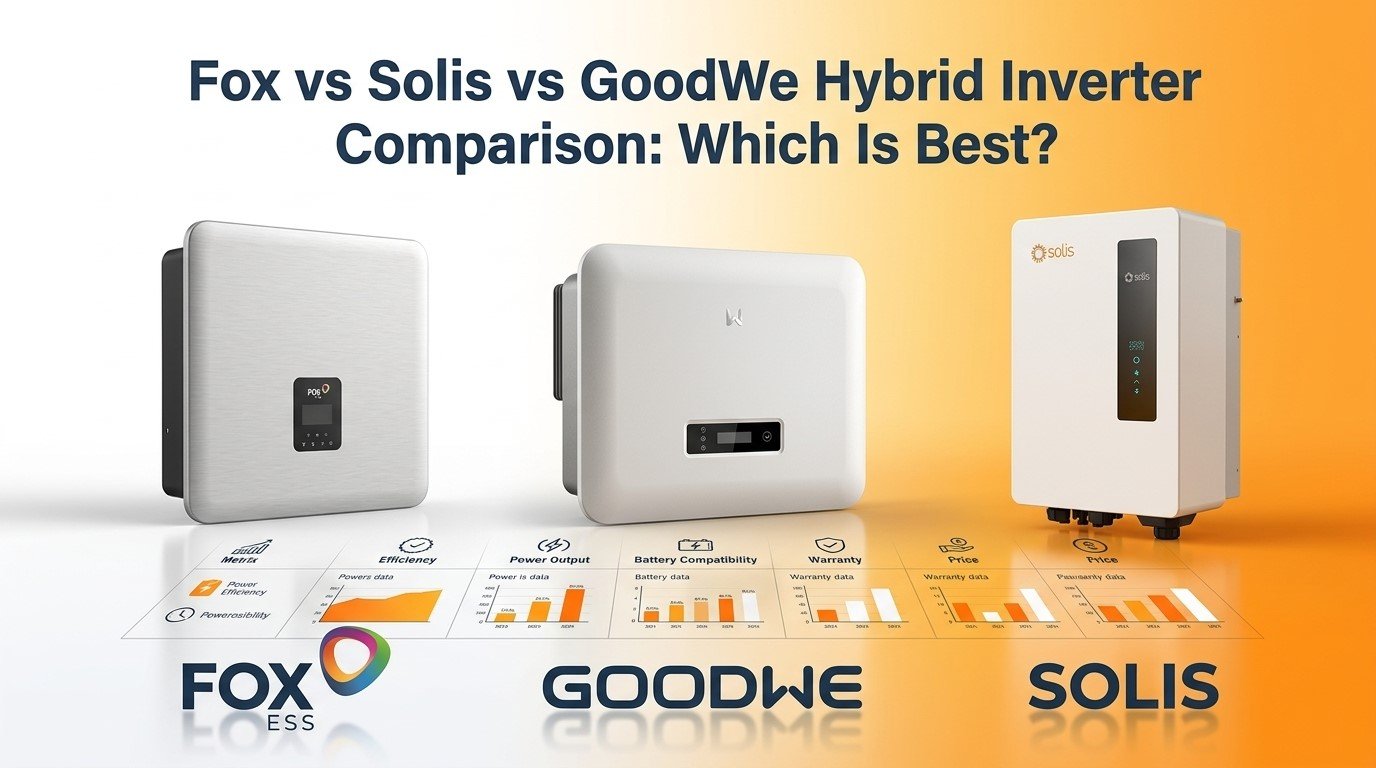
Fox vs Solis vs GoodWe Hybrid Inverter: Quick Comparison
Fox ESS, Solis, and GoodWe offer different inverter families designed for different installation requirements. The following comparison provides a general overview rather than a ranking of every model from each manufacturer.
| Feature | Fox ESS | Solis | GoodWe |
|---|---|---|---|
| Main strength | Integrated solar and battery solutions | Flexible inverter options across different system sizes | Broad residential and commercial energy solutions |
| Hybrid inverter options | Residential and larger hybrid ranges | Residential and commercial hybrid ranges | Residential and commercial hybrid ranges |
| Battery integration | Model-specific, with compatible battery options | Model-specific, with approved battery options | Model-specific, with compatible battery options |
| Monitoring | App and web-based monitoring on supported models | Monitoring options depend on the inverter and communication equipment | Monitoring options depend on the inverter and monitoring platform |
| Backup power | Depends on model and backup configuration | Depends on model and backup configuration | Depends on model and backup configuration |
| Installation considerations | Battery and inverter compatibility, system configuration | Battery matching, inverter configuration, system design | Battery matching, system configuration, monitoring setup |
| Best suited for | Buyers seeking a compatible Fox ESS solar and storage ecosystem | Buyers comparing a broad range of solar inverter options | Buyers seeking a broad residential or commercial energy solution |
The most important point is that brand names alone do not determine performance. A smaller residential hybrid inverter should not be compared directly with a larger three-phase commercial model. Always compare products with similar rated capacity, phase configuration, battery voltage, and backup output.
1. Fox ESS Hybrid Inverter Review
Fox ESS is a manufacturer of solar inverters and energy storage solutions. Its product range includes hybrid inverters designed to work with compatible batteries, allowing homeowners to combine solar generation with stored energy.
Fox ESS may be worth considering if you want a solar and battery system designed around a coordinated inverter and storage solution.
Key Features of Fox ESS Hybrid Inverters
Fox ESS offers multiple inverter series, and the specifications differ between generations and models. Depending on the selected product, features may include:
- Hybrid operation with compatible battery storage.
- Solar panel input for residential energy generation.
- Battery charging and discharging management.
- Remote monitoring through supported digital platforms.
- Outdoor installation capability on appropriately rated models.
- Support for expanding battery storage within specified system limits.
- Integration with compatible Fox ESS energy storage products.
For example, the Fox ESS H1 and AC1 G2 product families include residential hybrid or AC-coupled inverter options, with models spanning several power ratings. The manufacturer’s datasheet describes high-voltage battery support, remote monitoring, and battery expansion options for the relevant series. Exact specifications depend on the selected model. Fox ESS H1 and AC1 G2 datasheet.
Battery Compatibility of Fox ESS Inverters
Battery compatibility is one of the most important factors when purchasing a Fox ESS hybrid inverter.
A hybrid inverter cannot necessarily operate with every lithium battery available in the market. The battery’s voltage, communication protocol, battery management system, charging limits, and firmware compatibility must match the inverter.
Fox ESS provides battery products designed to work with its inverter ecosystem. However, buyers should verify the supported battery models for their exact inverter series before making a purchase.
If you are planning to install a hybrid solar system in Pakistan, ask your installer to confirm:
- Whether the proposed battery is approved for the inverter model.
- Whether the inverter supports the battery’s voltage and communication protocol.
- The maximum supported battery capacity.
- The permitted battery charging and discharging power.
- Whether the system can be expanded with additional battery modules.
- Which warranties apply to the inverter and battery combination.
Choosing a compatible battery can help prevent communication problems and support proper system operation.
Backup Performance of Fox ESS Hybrid Inverters
For Pakistani households, backup performance can be a major reason to consider a hybrid inverter.
Fox ESS hybrid models may support backup operation, but the exact capability depends on the product series, installation design, and required accessories. Buyers should confirm the inverter’s continuous backup power, surge capability, supported backup circuits, and changeover arrangements.
For example, running lights, fans, a refrigerator, and a television requires less power than running multiple air conditioners, a water pump, and kitchen appliances simultaneously.
A hybrid inverter may also need a separate backup output or an appropriate electrical configuration to supply selected loads during an outage. Do not assume that every household circuit will remain powered automatically.
Monitoring and Energy Management
Remote monitoring can help homeowners understand how their solar system performs throughout the day.
On supported Fox ESS systems, monitoring tools allow users to review relevant information such as solar generation, battery status, and system operation. Available information depends on the inverter, communication hardware, software, and system configuration.
This can be helpful if you want to understand whether your home is using solar electricity directly, charging the battery, or importing electricity from the grid.
Advantages of Fox ESS Hybrid Inverters
Potential advantages include:
- An integrated range of inverter and battery products.
- Residential hybrid inverter options for different system sizes.
- Remote monitoring on supported models.
- Battery expansion options on selected product families.
- Suitability for households planning solar generation and storage together.
Things to Check Before Buying Fox ESS
Before selecting a Fox ESS inverter, verify the exact model’s technical specifications, battery compatibility, backup capability, local warranty arrangements, and availability of replacement equipment.
Also ask about installation support and troubleshooting. A feature-rich inverter is most useful when it is correctly installed and supported by a qualified service provider.
Fox ESS may be a suitable option for homeowners who want an integrated solar and storage system, but the final decision should depend on the specific model and total installation cost.
2. Solis Hybrid Inverter Review
Solis is a solar inverter manufacturer offering grid-tied, hybrid, and energy storage inverter solutions across different system sizes.
Its broad product range makes it worth considering for homeowners, businesses, and installers comparing different solar system configurations.
Solis offers residential hybrid products as well as larger solutions for commercial applications. The precise features available depend on the product family, inverter capacity, and the market for which the unit was designed.
Key Features of Solis Hybrid Inverters
Depending on the model, Solis hybrid inverters may offer:
- Solar generation and battery integration.
- Battery charging and discharging management.
- Monitoring and system performance reporting.
- Grid-connected operation.
- Backup functionality on supported models.
- Options for different residential and commercial installation requirements.
- Compatibility with selected third-party battery brands.
One reason to consider Solis is the range of available inverter configurations. However, a product sold in one country may have different electrical ratings, grid settings, or certifications from a similarly named model sold elsewhere.
For a Pakistani installation, confirm that the proposed inverter is appropriate for the local grid, the required phase configuration, and the intended battery setup.
Battery Compatibility of Solis Hybrid Inverters
Battery compatibility deserves particular attention when evaluating Solis hybrid inverters.
Solis publishes battery compatibility information for supported inverter families. The manufacturer explains that approved battery matching helps ensure correct communication between the inverter and the battery management system. Using an unverified battery may create operating issues and can affect warranty coverage, depending on the applicable product terms. Solis battery compatibility guidance.
This matters because two batteries with similar voltage and capacity are not necessarily interchangeable.
Before buying a Solis hybrid inverter, confirm the following:
- The exact inverter model supports the proposed battery.
- The battery’s communication protocol is supported.
- The battery capacity is within the permitted limits.
- The charging and discharging power meets your requirements.
- The selected combination is supported under the applicable warranty terms.
If you already own a battery and want to add a Solis inverter, check compatibility before purchasing the equipment.
Backup Power and Load Shedding
Solis hybrid inverters may provide backup power when the selected model and installation support this function.
However, the presence of a battery connection does not automatically mean the inverter will power your home during load shedding. Backup output, electrical wiring, battery configuration, and installation settings all affect the result.
For Pakistani homes, it is important to decide which appliances need backup power.
A basic backup arrangement might support:
- LED lights.
- Ceiling fans.
- Internet equipment.
- A television.
- A refrigerator, subject to its power requirements.
If you also want to operate air conditioners or water pumps, you need to check the inverter’s continuous output rating, surge capability, battery discharge limit, and total load.
For a larger house, the installer should calculate both the required backup power and the energy needed over the expected outage period.
Monitoring and System Management
Monitoring options vary by Solis inverter series and installation configuration. Depending on the setup, homeowners may be able to review solar production, grid interaction, and battery operation through supported monitoring equipment and software.
Monitoring can help identify unusual production patterns, changes in battery operation, and possible performance issues.
However, remote monitoring is not a substitute for correct installation or professional troubleshooting. The system must also have the necessary communication equipment and an appropriate internet connection if remote access is required.
Advantages of Solis Hybrid Inverters
Potential advantages include:
- A broad range of inverter products.
- Residential and commercial energy storage options.
- Compatibility with selected third-party batteries.
- Monitoring options on supported models.
- Different inverter configurations for different installation requirements.
Things to Check Before Buying Solis
The most important considerations are exact-model battery compatibility, backup output, warranty terms, grid configuration, and local technical support.
Ask your installer to provide the model number and relevant datasheet rather than relying on a general claim that Solis supports a particular feature.
Solis may be a good choice for buyers who want to compare multiple inverter capacities and system designs, especially when a suitable model and verified battery combination are available locally.
3. GoodWe Hybrid Inverter Review
GoodWe is a manufacturer of solar inverters and energy storage solutions serving residential and commercial markets.
Its portfolio includes hybrid inverter families designed for different power requirements, battery configurations, and installation types.
GoodWe may be worth considering if you want to compare residential energy storage systems alongside larger solutions for business or commercial use.
Key Features of GoodWe Hybrid Inverters
Depending on the inverter series, GoodWe hybrid products may provide:
- Solar panel integration.
- Battery charging and discharging.
- Grid-connected operation.
- Backup power capabilities on supported models.
- Energy monitoring and management.
- Integration with compatible GoodWe or approved third-party batteries.
- Options for single-phase and three-phase applications across the wider product range.
GoodWe’s product range includes low-voltage and high-voltage hybrid solutions, but availability and specifications differ by market and model.
The manufacturer’s Pakistan product page, for example, lists the ES Uniq low-voltage hybrid inverter family in 8kW to 12kW single-phase configurations, alongside other inverter and storage products. This demonstrates why checking the local product lineup is important instead of assuming that every GoodWe model is available in every market. GoodWe Pakistan product range.
Battery Compatibility of GoodWe Hybrid Inverters
GoodWe offers battery integration across selected hybrid inverter families. However, compatibility depends on the exact inverter series and battery model.
GoodWe publishes battery compatibility documentation covering supported battery models and inverter families. The documentation identifies which combinations are supported, so installers should verify the relevant pairing before installation. GoodWe battery compatibility overview.
Before choosing a GoodWe hybrid inverter, check:
- Whether your intended battery model is supported.
- Whether the inverter uses low-voltage or high-voltage storage.
- The permitted battery capacity and maximum power.
- The communication requirements between the inverter and battery.
- Whether the battery can be expanded later.
- The applicable warranty conditions.
This is particularly important if you are comparing the price of a GoodWe inverter with a competing product. A lower-priced inverter may not provide the same overall value if the compatible battery options are more expensive or difficult to obtain.
Backup Performance of GoodWe Hybrid Inverters
GoodWe hybrid inverters may support backup operation, depending on the selected model and system design.
When evaluating backup performance, do not focus only on the inverter’s headline capacity. Check how much power is available at the backup output, whether there are limits on the supported loads, and how the system behaves when the grid supply fails.
You should also confirm whether the selected inverter requires additional switching equipment, backup wiring, or other components.
For a Pakistani home, the backup design should reflect your actual priorities. A system intended to run fans, lights, and a refrigerator will have different requirements from one intended to run several air conditioners during long power outages.
Monitoring and Energy Management
Monitoring can help you understand how solar generation, household consumption, grid electricity, and battery storage interact.
GoodWe offers monitoring and energy management options for supported products. The specific data and controls available depend on the inverter, communication equipment, and software platform.
This information can help homeowners identify when solar production is highest, whether battery charging is taking place as expected, and how much electricity is being drawn from the grid.
Advantages of GoodWe Hybrid Inverters
Potential advantages include:
- A broad range of residential and commercial inverter solutions.
- Hybrid options using different battery configurations.
- Monitoring and energy management features on supported products.
- Options for different power ratings and installation types.
- Compatibility with selected batteries, subject to model verification.
Things to Check Before Buying GoodWe
Before purchasing, confirm the availability of the exact model in Pakistan, battery compatibility, backup output, warranty coverage, and access to local technical support.
Also check whether the model suits your home’s phase configuration and electricity requirements. A larger commercial inverter may not be the most practical choice for a small residential installation.
GoodWe may be a strong candidate for buyers comparing advanced solar and storage configurations, but the most suitable option depends on the exact product and the quality of the complete installation.
Fox vs Solis vs GoodWe: Which Offers the Best Efficiency?
Efficiency is one of the most important specifications to review when comparing hybrid solar inverters. However, there is no single efficiency figure that applies to every Fox ESS, Solis, or GoodWe inverter.
Each manufacturer offers multiple product families, and efficiency depends on the model, operating conditions, input voltage, output load, and whether energy is passing through the battery charging and discharging process.
Solar Conversion Efficiency
Solar conversion efficiency describes how effectively an inverter converts the DC electricity produced by solar panels into usable AC electricity.
A higher conversion efficiency can reduce conversion losses, but the difference between two products should be assessed using their official datasheets and comparable test conditions.
When comparing inverter efficiency, look for:
- Maximum efficiency.
- Weighted or European efficiency, where published.
- Performance across different operating loads.
- The inverter’s supported voltage range.
- Standby and self-consumption requirements.
Do not compare a maximum efficiency figure from one model with a different type of efficiency figure from another.
Battery Charging and Discharging Efficiency
A hybrid solar system also experiences losses when charging and discharging a battery.
The complete energy path can include losses in the inverter, battery, wiring, and other system components. The resulting round-trip efficiency depends on the inverter, battery, operating conditions, and system design.
For a fair comparison, examine the efficiency specifications for the complete inverter and battery arrangement rather than looking only at the inverter’s solar conversion rating.
Which Brand Is the Most Efficient?
There is no responsible way to declare one of these three brands the universal efficiency winner without comparing the exact inverter models.
For example, one Fox ESS model may have different efficiency characteristics from another Fox ESS model. The same is true for Solis and GoodWe.
The best approach is to compare the technical datasheets for the specific products available to you. If two models have similar ratings and operating characteristics, then warranty support, battery compatibility, installation quality, and overall price can become more important factors in the decision.
Fox vs Solis vs GoodWe: Which Is Better for Battery Backup?
Battery backup is especially important for homeowners who experience frequent load shedding.
A hybrid inverter can coordinate solar panels and battery storage, but its backup performance depends on several specifications.
Inverter Output Power
The inverter must provide sufficient power for the appliances you intend to operate simultaneously.
For example, a backup load containing lights, fans, a refrigerator, and a television is generally easier to support than a load containing multiple air conditioners and a water pump.
The inverter’s continuous output and surge rating should be checked against the actual load requirements.
Battery Capacity
Battery capacity is usually expressed in kilowatt-hours (kWh). It indicates how much energy the battery can store, although the usable amount depends on the battery’s specifications and operating limits.
A larger battery can generally support a given load for longer, but it will not help if the inverter cannot deliver the required power.
Battery Discharge Power
The battery must be able to supply the required discharge power. A battery with a large energy capacity may still have a discharge limit that restricts how many high-power appliances can operate simultaneously.
Backup Configuration
The installation must include the correct backup output and wiring arrangement. Some systems supply only selected circuits during an outage, while others support more extensive backup configurations.
Which Brand Is Best for Load Shedding?
Fox ESS, Solis, and GoodWe all offer products intended for energy storage applications, but their backup capabilities vary by model.
The most suitable inverter is the one that can supply your required backup load, communicate properly with your battery, and receive appropriate technical support.
Before making a purchase, ask the installer to demonstrate how the system will operate during a grid outage and identify which appliances will remain powered.
Fox vs Solis vs GoodWe: Which Inverter Supports More Batteries?
Battery compatibility is not simply a matter of how many battery brands an inverter manufacturer lists.
The number of supported batteries, permitted battery capacity, and available battery configurations depend on the inverter model.
Fox ESS offers compatible storage products within its own ecosystem. Solis supports selected batteries and publishes model-specific compatibility information. GoodWe also publishes compatibility documentation for its hybrid inverter families.
For all three brands, you should check:
- The exact inverter model number.
- The battery manufacturer and model.
- Whether the battery is low-voltage or high-voltage.
- The communication protocol required.
- The permitted number of battery modules.
- The maximum battery charging and discharging power.
- The relevant warranty requirements.
If you already have a battery, do not assume that it will work with a new inverter simply because both products use lithium-ion technology.
Likewise, if you plan to expand your battery capacity in the future, confirm that the inverter supports the proposed expansion and that the additional modules can be installed in accordance with the manufacturer’s instructions.
Fox vs Solis vs GoodWe: Which Is Best for a 5kW Solar System?
A 5kW solar system is a common size to investigate for a residential property with moderate electricity consumption.
When selecting a 5kW hybrid inverter, consider the following factors.
Fox ESS for a 5kW Solar System
A suitable Fox ESS residential hybrid model may be worth considering if you want to combine solar generation with a compatible battery solution.
Check the inverter’s allowable solar panel capacity, battery requirements, backup output, and expansion limits.
Solis for a 5kW Solar System
A suitable Solis hybrid model may be worth comparing if you want to evaluate different inverter configurations and compatible storage options.
Confirm the exact model’s specifications and battery matching requirements before purchasing.
GoodWe for a 5kW Solar System
A GoodWe hybrid inverter should be evaluated based on the availability of an appropriate model for your required capacity and battery configuration.
Check whether the model suits your intended installation and whether its backup output meets your household’s needs.
What Should You Choose?
For a 5kW installation, compare three specific inverter models with similar ratings and operating requirements. Review their datasheets, battery compatibility, backup power, warranties, and complete installed prices.
Do not choose an inverter based solely on its brand or the seller’s claim that it is the best option.
Fox vs Solis vs GoodWe: Which Is Best for a 10kW Solar System?
A 10kW solar system may suit a larger home or a property with higher electricity consumption. It can also be considered for certain business applications, depending on the load and installation requirements.
However, a 10kW solar array and a 10kW inverter are not automatically the same thing. The panel capacity, inverter’s AC output rating, and permitted DC input must all be considered when designing the system.
Important Factors for a 10kW Hybrid Inverter
Before selecting a 10kW-class hybrid inverter, review:
- Whether a single-phase or three-phase inverter is required.
- The maximum permitted solar panel capacity.
- The inverter’s voltage and current limits.
- Battery voltage and supported storage capacity.
- Backup output and surge capability.
- The required electrical protection and wiring.
- Applicable utility and grid-connection requirements.
Fox ESS, Solis, and GoodWe each offer multiple product families, but not every model is appropriate for every installation.
The best choice is the model that satisfies your technical requirements and offers a reliable, supportable installation at a competitive total cost.
Which Hybrid Inverter Is Best for Pakistan?
There is no single hybrid inverter brand that is best for every Pakistani home. Your requirements will depend on electricity consumption, load shedding, battery storage, roof space, system size, budget, and access to local technical support.
Here is how to approach the decision.
Choose Fox ESS If You Prefer a Coordinated Solar and Storage Solution
Fox ESS may be worth considering if you want to explore a compatible inverter and battery ecosystem.
Compare the available residential models, battery configurations, backup features, and warranty terms. Ensure that the proposed combination is supported for the exact model being installed.
Choose Solis If You Want to Compare Multiple Inverter Configurations
Solis may be worth considering if you want to compare different residential and commercial inverter families and selected third-party battery options.
Review the available model, approved battery combinations, backup functionality, and local service arrangements before making a decision.
Choose GoodWe If You Want to Explore a Broad Range of Energy Solutions
GoodWe may be worth considering if you want to evaluate residential hybrid systems alongside larger energy storage solutions.
Check the availability of the required model in Pakistan, battery compatibility, monitoring options, and technical support.
Compare Local Availability Before Making Your Final Decision
For a solar installation in Pakistan, local availability and after-sales service can be just as important as the inverter’s technical specifications.
Ask the seller or installer:
- Is the product supplied through an authorized or traceable distribution channel?
- What is the written warranty period and what conditions apply?
- Where can the inverter be serviced?
- Are replacement parts and communication accessories available?
- Is technical support available for configuration and troubleshooting?
- Is the proposed battery officially compatible with the exact model?
A slightly cheaper inverter may not represent better value if it is difficult to service or if its compatible batteries are unavailable.
How Much Does a Hybrid Inverter Cost in Pakistan?
The price of a hybrid inverter in Pakistan depends on its rated capacity, model, battery voltage, features, warranty, exchange rates, import costs, and local availability.
Prices can also change over time. For this reason, it is better to obtain a current quotation for the exact model instead of relying on a general brand-level estimate.
When comparing quotations for Fox ESS, Solis, and GoodWe, check whether the price includes only the inverter or also includes:
- Battery storage.
- Monitoring equipment.
- Backup switching or related accessories.
- Installation and commissioning.
- Electrical protection equipment.
- Wiring and other installation materials.
- Warranty support.
Remember that the inverter is only one part of a hybrid solar installation. Battery capacity, solar panels, mounting structures, wiring, and installation labour can substantially affect the total cost.
A fair comparison should use complete system quotations with equivalent capacities and similar backup requirements.
How to Calculate the Right Hybrid Inverter Size for Your Home
Selecting an inverter requires more than looking at your monthly electricity units.
First, review your recent electricity bills to understand your average consumption. Then identify the appliances that operate simultaneously and determine which ones must remain powered during load shedding.
For example, if your household consumes 600 units per month, its average daily electricity consumption is approximately 20kWh. This information can help estimate the required solar panel capacity, but it does not automatically determine the correct inverter rating.
You must also consider the maximum load that could operate at one time.
A household with several air conditioners may require a different inverter configuration from a household with the same daily energy consumption but lower peak demand.
Your installer should assess:
- Average daily electricity consumption.
- Maximum simultaneous appliance load.
- Solar panel array capacity.
- Battery charging and discharging requirements.
- Backup power requirements.
- Single-phase or three-phase supply.
- Inverter voltage and current limits.
- Potential future expansion.
This assessment helps ensure that the solar panels, inverter, battery, and electrical system work together correctly.
Common Mistakes to Avoid When Buying a Hybrid Solar Inverter
1. Choosing Only by Brand Name
Fox ESS, Solis, and GoodWe each offer different models. A brand-level comparison cannot tell you whether a particular inverter is appropriate for your home.
Always compare the exact model numbers and technical specifications.
2. Ignoring Battery Compatibility
An inverter and battery must be compatible in terms of voltage, communication, power limits, and supported configurations.
Verify the manufacturer’s compatibility information before purchasing the equipment.
3. Assuming Every Hybrid Inverter Provides Full Home Backup
Some inverters support backup for selected circuits, while others may have different output limits or configuration requirements.
Confirm the backup arrangement before installation.
4. Buying an Inverter Without Checking Warranty Support
Warranty conditions, authorized service arrangements, and local parts availability can affect the long-term value of your investment.
Request written warranty details and keep your purchase documentation.
5. Ignoring the Total System Cost
The lowest inverter price does not always produce the lowest overall installation cost.
Compare the inverter, battery, installation, protection equipment, and warranty support as a complete package.
6. Installing an Oversized or Undersized System
The solar array, inverter, and battery should match your energy consumption and power requirements.
A qualified installer should calculate the appropriate system size rather than selecting equipment based only on a general recommendation.
Frequently Asked Questions About Fox vs Solis vs GoodWe Hybrid Inverters
1. Which is better, Fox ESS, Solis, or GoodWe?
The best choice depends on the exact inverter model, battery compatibility, backup requirements, warranty, price, and local support. Fox ESS may appeal to buyers seeking a coordinated storage ecosystem, Solis offers a broad range of inverter options, and GoodWe provides residential and commercial energy solutions. Compare equivalent models before deciding.
2. Which hybrid inverter is best for load shedding in Pakistan?
The best inverter for load shedding is one that supports your required backup load, works with a compatible battery, and has suitable backup output and switching arrangements. Fox ESS, Solis, and GoodWe each have models to investigate, but you should verify the specifications of the exact product.
3. Are Fox ESS hybrid inverters compatible with all lithium batteries?
No. Compatibility depends on the inverter model, battery voltage, communication protocol, battery management system, and manufacturer approval. Check the relevant compatibility documentation before connecting a battery.
4. Can Solis hybrid inverters work with third-party batteries?
Selected Solis hybrid inverters support approved third-party batteries. However, compatibility varies by inverter series and battery model. Consult the official compatibility list for the exact product.
5. Does GoodWe support battery storage?
Yes, GoodWe offers hybrid inverter families designed for compatible battery storage. The supported battery models and configurations depend on the inverter series. Check the manufacturer’s compatibility documentation before purchasing.
6. Which brand is best for a 5kW hybrid solar system?
The best 5kW option depends on the exact model, battery arrangement, backup requirements, warranty, and installed price. Compare products with similar ratings and confirm that the inverter can support the proposed solar array and battery.
7. Which brand is best for a 10kW solar system?
For a 10kW-class system, compare suitable Fox ESS, Solis, and GoodWe models based on phase configuration, allowable solar input, battery compatibility, backup output, and local support. A qualified installer should verify that the selected equipment is suitable for your property.
8. Is a hybrid inverter worth the extra cost?
A hybrid inverter may be worth the extra cost if you want battery storage, backup during load shedding, or greater flexibility in managing solar energy. If your primary goal is to reduce daytime electricity purchases and you do not need backup power, an on-grid system may also be worth considering.
9. How long does a hybrid solar inverter last?
The service life depends on the model, installation quality, operating conditions, maintenance, and environmental exposure. Check the manufacturer’s warranty and product documentation instead of assuming every inverter will last the same number of years.
10. Should I buy an inverter first and select the battery later?
It is better to plan the inverter and battery together, even if you intend to buy the battery at a later stage. This allows you to verify battery compatibility, voltage requirements, expansion limits, and backup performance before committing to the system.
Conclusion: Fox vs Solis vs GoodWe Hybrid Inverter Comparison
Fox ESS, Solis, and GoodWe are all worth considering when comparing hybrid solar inverters for homes and businesses in Pakistan. However, choosing the right inverter requires a detailed assessment of your electricity needs, battery requirements, solar array capacity, backup expectations, and budget.
Fox ESS may be suitable for buyers interested in a coordinated inverter and battery solution. Solis is worth evaluating for its range of inverter configurations and selected third-party battery compatibility. GoodWe offers a broad portfolio of residential and commercial energy solutions, with battery support depending on the product family.
No brand should be declared the universal winner without comparing specific inverter models under equivalent conditions.
Before making your final decision, obtain the datasheets for the exact Fox ESS, Solis, and GoodWe models you are considering. Compare their efficiency ratings, battery compatibility, backup power, warranty terms, installation costs, and local after-sales support.
The best hybrid solar inverter is the one that matches your home’s electricity requirements, supports your chosen battery, provides the backup capability you need, and offers reliable long-term service at a reasonable total cost.