Installing solar panels is one of the most effective ways to reduce electricity bills, use renewable energy, and improve your home’s energy independence. However, before investing in a solar system, one important question needs to be answered: How many solar panels do you need for your home?
The answer depends on several factors, including your monthly electricity consumption, the wattage of your solar panels, the number of air conditioners you use, your roof space, your location, and whether you want to run appliances during load shedding. Choosing the correct number of solar panels can help you avoid unnecessary installation costs while ensuring that your solar system produces enough electricity for your household.
In Pakistan, where residential electricity consumption can increase significantly during summer because of air conditioners, refrigerators, water pumps, and other appliances, calculating your solar requirements carefully is especially important.
This detailed guide explains how to calculate the number of solar panels required for your home, how much electricity solar panels can generate, which solar system size may suit your household, and what to consider before installing a residential solar system in Pakistan.
How Many Solar Panels Do You Need for Your Home?
The number of solar panels required for a home depends primarily on how much electricity the household consumes each day and the wattage of the panels being installed.
A small household with moderate electricity consumption may need approximately 5 to 7 modern solar panels, while a larger home that operates multiple air conditioners may require 15 to 20 panels or more.
For example, if you install 550-watt solar panels, your estimated panel requirements could look like this:
| Solar system size | Number of 550W panels |
|---|---|
| 3kW solar system | 6 panels |
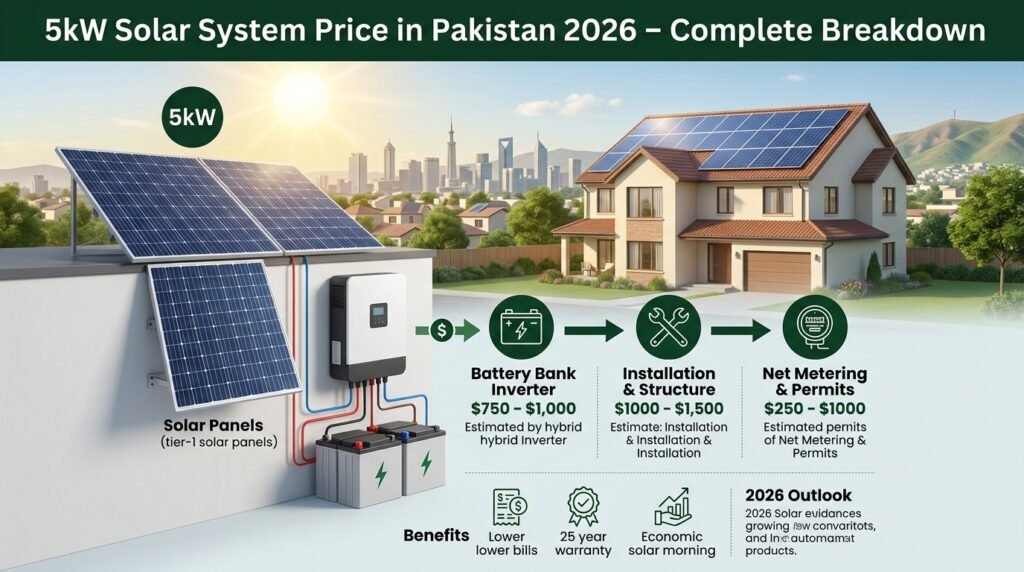
| 5kW solar system | 10 panels |
| 6kW solar system | 11 panels |
| 8kW solar system | 15 panels |
| 10kW solar system | 19 panels |
These are approximate panel counts based on total panel capacity, rounded up where necessary. The final number may vary depending on the actual panel wattage, inverter specifications, system design, and the amount of electricity you want to generate.
For example, ten 550-watt solar panels provide a combined rated capacity of 5.5kW. This is a common way to build a solar array around a nominal 5kW inverter, provided the inverter manufacturer permits the proposed panel capacity.
However, the size of your solar system should not be selected only by looking at your home’s covered area or the number of rooms. Your electricity consumption is the most important starting point.
Why Is It Important to Calculate the Number of Solar Panels Correctly?
Choosing the correct number of solar panels can directly affect your electricity savings, initial investment, and long-term solar performance.
If your solar system is too small, it may not generate enough electricity to meet your household’s daily needs. You may continue purchasing a considerable amount of electricity from the grid, especially during summer when air conditioning increases consumption.
On the other hand, installing more solar panels than you need can increase your initial expenses without providing proportional financial benefits. Any excess electricity may be exported to the grid, stored in a battery if your system supports it, or remain unused when your household cannot consume it.
This is particularly important when evaluating solar export arrangements in Pakistan because the value of exported electricity can differ from the price you pay for electricity imported from the grid. Check the applicable rules and your electricity provider’s current requirements before sizing a system primarily for exporting surplus power.
A properly sized residential solar system should consider:
- Your average monthly electricity consumption.
- Your highest electricity consumption during summer.
- The appliances you operate during daylight hours.
- Your nighttime electricity requirements.
- Your location and available sunlight.
- Solar panel wattage and efficiency.
- Roof orientation, shading, and available installation space.
- Whether you need battery backup during load shedding.
- Your budget and expected long-term savings.
Considering these factors before installation helps you choose a solar solution that matches your actual energy requirements.
Step 1: Check Your Monthly Electricity Consumption
The first step in calculating how many solar panels you need is checking your electricity bills.
Your electricity bill normally shows the number of units consumed during the billing period. One electricity unit is equivalent to one kilowatt-hour, commonly written as kWh.
For example, if your monthly electricity bill shows 600 units, your household consumes approximately 600kWh of electricity per month.
To calculate your average daily electricity consumption, divide your monthly units by 30.
Formula:
Daily electricity consumption = Monthly electricity units ÷ 30
For example:
600 units ÷ 30 days = 20 units per day.
This means your home uses approximately 20kWh of electricity daily.
Here are some additional examples:
| Monthly electricity consumption | Average daily consumption |
|---|---|
| 300 units | 10kWh |
| 450 units | 15kWh |
| 600 units | 20kWh |
| 750 units | 25kWh |
| 900 units | 30kWh |
| 1,200 units | 40kWh |
These calculations provide a useful starting point for determining your solar requirements.
However, avoid relying on only one electricity bill. Review your previous six to twelve months of bills if available. Electricity consumption can change significantly between winter and summer, particularly in Pakistani households that use multiple air conditioners.
If your summer electricity consumption is much higher than your winter consumption, your solar system should be designed with that difference in mind.
Step 2: Calculate the Solar System Size You Need
Once you know your average daily electricity consumption, the next step is estimating the required solar system capacity.
Solar panels are rated in watts, while residential solar systems are usually described in kilowatts. One kilowatt equals 1,000 watts.
For example:
- A 450-watt solar panel has a rated capacity of 0.45kW.
- A 550-watt solar panel has a rated capacity of 0.55kW.
- A 600-watt solar panel has a rated capacity of 0.60kW.
The amount of electricity a solar system generates depends on its rated capacity, sunlight availability, panel orientation, temperature, dust, shading, and equipment efficiency.
For an initial estimate in Pakistan, you can use approximately 4.2kWh of daily electricity generation per installed kilowatt of solar capacity. This is a planning assumption, not a guarantee. Actual production varies by city, season, and installation conditions.
Formula:
Required solar capacity in kW = Daily electricity consumption in kWh ÷ Estimated daily generation per kW
For example, suppose your home consumes 20kWh per day.
20 ÷ 4.2 = approximately 4.76kW.
This means you may need around 4.8kW of solar panel capacity to produce an amount of electricity close to your average daily consumption under the assumed conditions.
In practice, you would discuss a suitable panel array and inverter combination with a qualified installer. The design may need to be larger if your roof receives less sunlight, your summer demand is high, or you want additional production during less sunny periods.
You can use this method to estimate your solar requirements before requesting a detailed installation quotation.
Step 3: Calculate the Number of Solar Panels Required
After estimating your required solar capacity, calculate how many panels are needed based on their individual wattage.
Formula:
Number of solar panels = Required solar capacity in watts ÷ Wattage of one solar panel
For example, suppose your estimated solar capacity requirement is 5,000 watts and you plan to install 550-watt panels.
5,000 ÷ 550 = 9.09 panels.
Since you cannot install a fraction of a solar panel, the calculation rounds up to 10 panels.
Ten 550-watt panels provide a total rated capacity of 5,500 watts, or 5.5kW.
This example shows why the number of panels depends on both the required system capacity and the wattage of the panels selected.
If you choose higher-wattage panels, you may need fewer panels to achieve a similar total capacity. However, higher-wattage panels can have different physical dimensions, so roof space and mounting arrangements must also be considered.
Example: Calculating Solar Panels for a 600-Unit Household
Suppose your household consumes 600 electricity units per month.
Step 1: Calculate daily consumption.
600 ÷ 30 = 20kWh per day.
Step 2: Estimate the required solar capacity.
20 ÷ 4.2 = 4.76kW.
Step 3: Convert the capacity into watts.
4.76 × 1,000 = 4,760 watts.
Step 4: Calculate the number of 550-watt panels.
4,760 ÷ 550 = approximately 8.65 panels.
You would need at least 9 panels to reach the calculated panel capacity, giving you 4.95kW of rated solar capacity.
This is an initial estimate. A professional installer should verify the final panel count, inverter compatibility, expected generation, and seasonal performance before installation.
How Many Solar Panels Do You Need Based on Monthly Electricity Units?
Many homeowners want a simple estimate based on their monthly electricity consumption. The following table provides a useful starting point for residential solar planning in Pakistan.
The estimates use 550-watt panels and an assumed average daily yield of 4.2kWh per installed kilowatt. Panel counts are rounded up to the next whole panel.
| Monthly units | Estimated panel capacity | Approximate 550W panels |
|---|---|---|
| 300 units | 2.4kW | 5 panels |
| 400 units | 3.2kW | 6 panels |
| 500 units | 4.0kW | 8 panels |
| 600 units | 4.8kW | 9 panels |
| 700 units | 5.6kW | 11 panels |
| 800 units | 6.4kW | 12 panels |
| 900 units | 7.1kW | 13 panels |
| 1,000 units | 7.9kW | 15 panels |
| 1,200 units | 9.5kW | 18 panels |
These are estimated panel capacities for energy planning, not guaranteed system recommendations. The final system size may need adjustment for shading, winter production, daytime consumption, battery charging, inverter limits, and the electricity export rules applicable to your connection.
Also remember that a solar system can produce enough electricity over an average day without covering every unit you consume at the exact time you need it. Your actual electricity bill depends on when your panels generate power, when your appliances use electricity, and whether you have suitable battery storage or an approved grid-export arrangement.
How Many Solar Panels Do You Need for Different Types of Homes?
Not every home has the same electricity requirements. A household that primarily uses fans, lights, and a refrigerator has very different needs from a home that operates three air conditioners, a water pump, an electric oven, and other high-consumption appliances.
Below are some common household situations and the factors to consider when estimating their solar requirements.
1. Small Home With Basic Appliances
A small home may use electricity for:
- Ceiling fans.
- LED lights.
- A refrigerator.
- A television.
- Mobile phone charging.
- A washing machine used periodically.
If your household consumes approximately 250 to 350 units per month, an initial estimate may suggest a solar array around 2kW to 3kW, depending on your location and the generation assumptions used.
With 550-watt panels, a 3kW array would require approximately six panels.
However, your actual requirements depend on appliance usage and the amount of electricity you want solar to cover. A home that uses electricity mainly at night may need a different system design from one that uses most of its electricity during the day.
2. Medium-Sized Family Home
A medium-sized family home may include several bedrooms, multiple ceiling fans, a refrigerator, a washing machine, a television, lighting, and one air conditioner.
If your monthly electricity consumption ranges from approximately 400 to 700 units, you may want to evaluate a solar system in the 3kW to 6kW range as an initial planning estimate.
For example, an array consisting of ten 550-watt panels provides 5.5kW of rated panel capacity.
This size may be suitable for some households, but it is not automatically the best choice for every family. An installer should review your electricity consumption, daytime appliance usage, roof conditions, and inverter requirements before recommending the final design.
3. Home With One or Two Air Conditioners
Air conditioners can significantly increase electricity consumption, particularly during Pakistan’s hot summer months.
If you regularly operate one or two air conditioners, your solar requirements may be considerably higher than those of a household that only uses fans and lights.
The actual electricity consumption of an air conditioner depends on its cooling capacity, inverter technology, temperature settings, insulation, room size, outdoor temperature, and operating hours.
For example, a household consuming 700 to 1,000 units per month may investigate a system around 5kW to 8kW, but the appropriate size depends on how much of that consumption you want to offset and when the air conditioners operate.
If you want to run air conditioners during load shedding, you must also check the inverter’s backup capability, battery capacity, and the air conditioner’s starting and running requirements. Solar panel capacity alone does not guarantee backup power.
4. Large Home With Multiple Air Conditioners
Large houses with three or more air conditioners, water pumps, refrigerators, and other high-power appliances can have substantial electricity requirements.
A household consuming approximately 1,000 to 1,500 units per month may need to investigate a solar array in the 8kW to 12kW range or another size based on a detailed energy assessment.
For example, a 10kW solar array made from 550-watt panels would require approximately 19 panels to reach or exceed the target capacity.
A larger solar installation also requires additional attention to roof space, panel layout, inverter capacity, wiring, protection equipment, and applicable utility connection requirements.
For large homes, a professional load assessment is particularly valuable because simply matching the solar array to the monthly units may not address peak loads or backup requirements.
How Many Solar Panels Do You Need for a 3kW Solar System?
A 3kW solar system is often considered by homeowners who have relatively moderate electricity consumption or limited roof space.
The number of panels depends on their wattage.
- With 450-watt panels, you need approximately 7 panels to reach 3kW.
- With 500-watt panels, you need 6 panels.
- With 550-watt panels, you need 6 panels.
- With 600-watt panels, you need 5 panels.
For example, six 550-watt panels provide a combined rated capacity of 3.3kW.
A 3kW solar system may help reduce electricity costs for a small household, but its performance depends on local sunlight, shading, orientation, and consumption patterns.
Before choosing this system size, review your monthly electricity units and identify whether you want to power essential appliances only or offset a larger portion of your household consumption.
How Many Solar Panels Do You Need for a 5kW Solar System?
A 5kW solar system is a common option for homeowners who want to reduce their electricity bills while powering a range of household appliances during sunny hours.
For a 5kW target capacity, the number of panels depends on their rated wattage:
- With 450-watt panels, approximately 12 panels are needed.
- With 500-watt panels, 10 panels are needed.
- With 550-watt panels, 10 panels are needed.
- With 600-watt panels, 9 panels are needed.
Ten 550-watt panels provide a total rated capacity of 5.5kW.
A suitable 5kW solar installation may help cover a substantial share of daytime electricity consumption in some homes. However, its ability to offset a monthly bill depends on household usage, the system’s actual generation, and whether excess electricity can be stored or exported under the applicable arrangement.
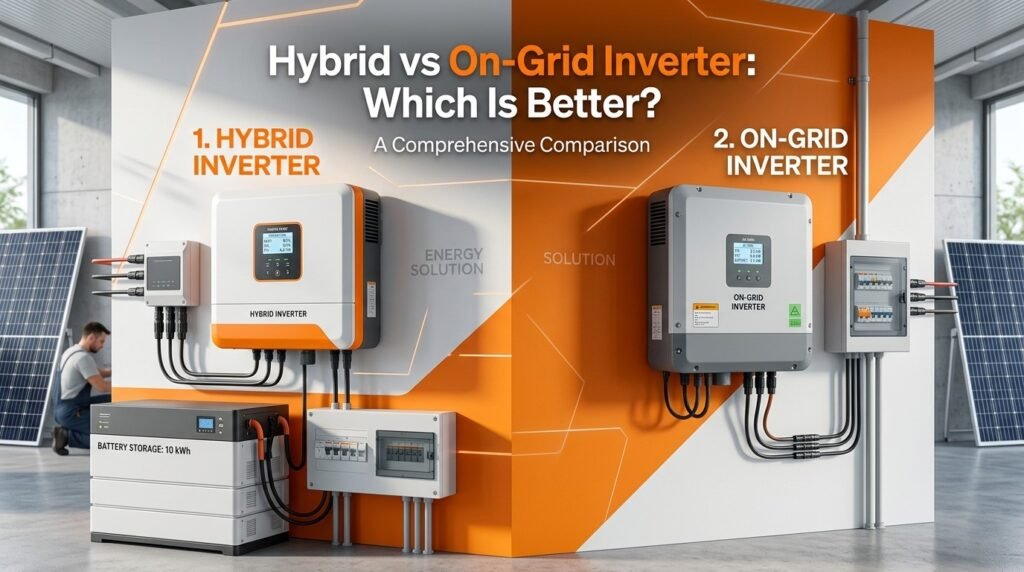
If you are planning a 5kW solar installation, compare on-grid and hybrid inverter options carefully. An on-grid system is generally designed to operate with the utility supply and usually shuts down during a grid outage for safety. A hybrid system can provide backup when paired with compatible batteries and configured appropriately.
How Many Solar Panels Do You Need for a 10kW Solar System?
A 10kW solar system may suit larger homes with high electricity consumption, particularly when several air conditioners and other energy-intensive appliances are used regularly.
The approximate panel count for a 10kW target is:
- With 450-watt panels, approximately 23 panels.
- With 500-watt panels, 20 panels.
- With 550-watt panels, 19 panels.
- With 600-watt panels, 17 panels.
For example, eighteen 550-watt panels provide 9.9kW of rated capacity, which is just below 10kW. Nineteen panels provide 10.45kW.
The inverter must be selected to support the proposed panel array and expected loads. A 10kW solar array also needs adequate roof space, safe mounting, correctly rated wiring, and appropriate electrical protection.
Homeowners should also verify any applicable sanctioned-load restrictions, interconnection requirements, and utility approval rules before finalizing the installation.
Which Solar Panel Wattage Is Best for Your Home?
Solar panel wattage affects how many panels you need to achieve a particular system capacity. Modern residential installations commonly use high-wattage panels, although the best option depends on the product available, the roof layout, and the electrical design.
450-Watt Solar Panels
A 450-watt panel can be a practical option when the available product dimensions and electrical specifications suit your roof and inverter.
Because each panel has a lower rated output than a 550-watt or 600-watt panel, you may need more panels to achieve the same total system capacity.
500-Watt Solar Panels
A 500-watt panel offers a middle ground between panel count and individual rated capacity.
Ten 500-watt panels provide a total rated capacity of 5kW.
550-Watt Solar Panels
A 550-watt panel can reduce the number of modules required for a given array capacity compared with lower-wattage panels.
For example, ten 550-watt panels provide 5.5kW of rated capacity.
600-Watt Solar Panels
A 600-watt panel can reduce the total panel count further, but you should compare its physical dimensions, weight, mounting requirements, and electrical characteristics before selecting it.
Not every high-wattage panel is automatically the best choice for every roof. Some larger modules may be harder to arrange on a small or irregular roof, and their voltage and current must be compatible with the inverter.
When comparing solar panels, consider efficiency, product warranty, degradation warranty, manufacturer reliability, local availability, and the installer’s ability to provide appropriate support.
How Much Roof Space Do You Need for Solar Panels?
Roof space is another important factor when planning a home solar system. Even if your budget supports a particular system size, your roof must have enough usable area to accommodate the panels safely.
The space required depends on the physical dimensions of each panel, the mounting arrangement, the distance between panel rows, roof access, and any required safety clearances.
For preliminary planning, a modern large-format panel may occupy roughly 25 to 30 square feet, although the actual dimensions vary by model. Additional area may be needed for walkways, spacing, maintenance access, and shading avoidance.
For example:
- Six panels may need approximately 150 to 180 square feet of panel area.
- Ten panels may need approximately 250 to 300 square feet of panel area.
- Fifteen panels may need approximately 375 to 450 square feet of panel area.
- Nineteen panels may need approximately 475 to 570 square feet of panel area.
These figures estimate panel area only and should not be treated as exact roof-space requirements. The total installation footprint can be larger.
Before installing solar panels, inspect the roof for water tanks, stairwell structures, nearby buildings, trees, and parapet walls that could cast shadows. Shading can reduce output and may affect an entire group of panels depending on the system design.
Your installer should also check the roof’s structural condition, waterproofing, mounting method, and access for future cleaning and maintenance.
How Much Electricity Can Solar Panels Generate Per Day?
Solar panel output depends on the rated panel capacity and the conditions under which the system operates.
A panel rated at 550 watts can produce up to its rated output under standard test conditions. It will not necessarily deliver 550 watts continuously throughout the day.
Real-world output changes with sunlight intensity, temperature, panel orientation, shading, dust accumulation, wiring losses, and inverter efficiency.
Using the planning assumption of approximately 4.2kWh per installed kilowatt per day, the estimated average daily generation might look like this:
| Solar array capacity | Estimated average daily generation |
|---|---|
| 3kW | 12.6kWh |
| 5kW | 21kWh |
| 6kW | 25.2kWh |
| 8kW | 33.6kWh |
| 10kW | 42kWh |
These are illustrative averages, not guaranteed daily output figures. Actual generation may be lower during cloudy weather, dusty periods, winter, or when panels are shaded. Output may be higher on favourable sunny days.
It is also important to distinguish solar generation from household electricity savings. If your panels generate 21kWh during the day but your home uses only 10kWh at that time, the remaining electricity does not automatically cover your nighttime consumption.
That surplus must be used by other loads, stored in a compatible battery, or exported through an approved grid connection. The financial value of exported electricity depends on the applicable billing arrangement.
How Many Solar Panels Do You Need to Run an Air Conditioner?
Air conditioners are among the most important appliances to consider when sizing a residential solar system in Pakistan.
However, there is no single number of solar panels that guarantees an air conditioner will operate correctly. The answer depends on the air conditioner’s actual electricity consumption, the number of hours it runs, the other appliances operating at the same time, and whether the system must continue operating during load shedding.
An inverter air conditioner may reduce its power consumption after reaching the desired room temperature, while a non-inverter unit may operate differently. Outdoor temperature, room insulation, cooling settings, and maintenance also affect energy use.
To estimate the energy requirement, check the air conditioner’s power rating or energy label and calculate its approximate daily electricity consumption.
Formula:
Daily energy consumption = Average power consumption in kW × Operating hours
For example, if an appliance averages 1kW of power consumption for 6 hours, it uses approximately 6kWh of electricity.
The actual average power consumption of an air conditioner can vary substantially, so use measured data or reliable manufacturer information where possible.
You must then add the energy consumption of other household appliances before estimating the complete solar system size.
For backup operation, the inverter and battery must also be capable of supporting the air conditioner and other selected loads. A system that can generate enough energy over a sunny day may still be unable to supply the required power at night or during a grid outage.
How Many Solar Panels Do You Need During Load Shedding?
Load shedding is an important consideration for households planning to install solar panels in Pakistan.
However, solar panels alone do not guarantee electricity during a power outage.
Most conventional grid-connected solar inverters shut down when the utility grid fails. This is a safety feature that prevents the system from sending electricity into a grid that may be under maintenance.
If you want backup power during load shedding, consider a compatible hybrid inverter or another properly designed backup system.
A hybrid solar installation can use solar panels, batteries, and the grid to supply selected household loads. The system’s actual backup duration depends on battery capacity, usable battery energy, inverter power, and the appliances being operated.
For example, running lights, fans, and a refrigerator requires a different battery capacity from running several air conditioners throughout the night.
Before choosing a hybrid solar system, identify the appliances that must remain operational during a power outage. Your installer can then calculate the required inverter capacity and battery storage.
On-Grid vs Hybrid Solar System: Which One Should You Choose?
Choosing between an on-grid and a hybrid solar system is an important part of planning your solar installation.
On-Grid Solar System
An on-grid solar system connects to the utility grid and normally uses solar electricity as it is generated.
Its potential advantages include:
- Lower initial cost than many battery-equipped systems.
- No battery replacement or battery maintenance requirements.
- Ability to use grid electricity when solar production is insufficient.
- Potential to export excess electricity when permitted under the applicable connection and billing arrangement.
The main limitation is that a conventional on-grid system usually does not provide backup during a grid outage.
Hybrid Solar System
A hybrid solar system can combine solar panels, the utility grid, and battery storage.
Its potential advantages include:
- Backup power for selected appliances.
- Ability to store some excess solar energy for later use.
- Greater flexibility in managing when solar electricity is consumed.
- Reduced dependence on the grid during suitable operating conditions.
However, hybrid systems generally cost more when batteries are included. Battery capacity must be chosen according to your nighttime electricity needs and backup expectations.
The right option depends on your budget, load-shedding experience, daytime consumption, nighttime usage, and the value you place on backup power.
What Factors Affect the Number of Solar Panels You Need?
Although monthly electricity consumption is the starting point, several other factors can change the number of solar panels required for your home.
1. Your Location in Pakistan
Solar conditions differ across Pakistan. Faisalabad, Lahore, Islamabad, Karachi, Multan, Quetta, and other cities can experience different sunlight levels, temperatures, dust conditions, and seasonal weather patterns.
A solar system should be sized using location-specific production estimates rather than assuming every city receives identical sunlight throughout the year.
2. Seasonal Electricity Consumption
Many Pakistani households use substantially more electricity during summer because of air conditioning and cooling appliances.
If you size your system using only a winter bill, you may underestimate your annual electricity needs.
Review bills from both summer and winter and consider whether your goal is to cover average annual consumption or meet a higher summer demand.
3. Daytime vs Nighttime Electricity Usage
Solar panels generally generate the most electricity during daylight hours. If you use most of your electricity during the day, you may be able to consume a larger share of your solar generation directly.
If your home uses more electricity at night, you may need grid electricity, battery storage, or a suitable combination of the two.
This distinction matters because generating a particular number of units over a day is not the same as having those units available at every hour.
4. Roof Shading
Shadows from water tanks, nearby buildings, trees, parapet walls, and other structures can reduce solar generation.
The impact depends on the location and duration of the shade, the electrical configuration, and the use of suitable inverter technology or module-level electronics.
A professional roof assessment can help identify the best panel placement and reduce avoidable production losses.
5. Solar Panel Efficiency
Panel efficiency indicates how effectively a panel converts available sunlight into electricity under specified test conditions.
Higher-efficiency panels can provide more rated power within a given roof area, although the best choice also depends on panel price, warranty, quality, and installation requirements.
6. Inverter Capacity
The inverter converts the electricity generated by the solar panels into electricity that household appliances can use.
Your installer must ensure that the inverter can support the selected panel array and household load. The allowable panel capacity, voltage range, current limits, and string configuration depend on the specific inverter model.
Installing additional panels without checking inverter compatibility can create design and performance problems.
7. Future Electricity Requirements
Your household’s energy needs may increase in the future. You may add another air conditioner, purchase an electric vehicle, install an electric water heater, or increase the number of appliances you use.
If you expect these changes, discuss future expansion with your installer. Planning for future needs may affect inverter selection, panel placement, wiring, and the initial system size.
Common Mistakes to Avoid When Calculating Solar Panel Requirements
Many homeowners make avoidable mistakes when selecting the number of solar panels for a home.
Choosing a Solar System Based Only on the Electricity Bill Amount
The rupee amount on an electricity bill can change because of tariffs, taxes, adjustments, and other charges. The number of electricity units consumed is generally a more useful starting point for estimating solar energy requirements.
Ignoring Summer Consumption
A system sized around low winter consumption may be insufficient during the summer months.
Review your historical electricity units and consider how much air conditioning you expect to use after installing solar.
Assuming Every Panel Produces Its Rated Wattage All Day
A 550-watt panel does not continuously produce 550 watts throughout daylight hours. Rated capacity describes its output under specified test conditions, while real-world output changes with the weather and installation conditions.
Ignoring Nighttime Electricity Requirements
Solar generation declines after sunset. If you need electricity at night, consider how the grid or battery storage will supply your home.
Installing More Panels Without Checking Inverter Compatibility
Every inverter has limits on supported panel capacity, input voltage, and current. Your installer should verify these specifications before finalizing the array.
Forgetting About Roof Space and Shading
A roof may appear large enough from the ground but have limited usable space because of water tanks, staircases, shadows, or maintenance access requirements.
Assuming Solar Automatically Eliminates the Electricity Bill
Solar can reduce electricity purchases, but it may not eliminate every charge or every unit imported from the grid. Your results depend on generation, consumption timing, backup requirements, and your applicable utility billing arrangement.
How to Choose the Right Solar Installation Company in Pakistan
Selecting a reliable solar installation company is just as important as calculating the number of panels you need.
A professional installer should evaluate your electricity consumption, inspect the roof, assess shading, and explain why the recommended panel count and inverter size suit your household.
Before choosing an installer, consider the following points:
- Ask for a detailed system design showing the number and wattage of the solar panels.
- Confirm the make and model of the inverter.
- Review the solar panel and inverter warranties.
- Request an estimate of expected monthly and annual electricity generation.
- Check whether the quotation includes the mounting structure, wiring, earthing, and electrical protection.
- Ask about monitoring, cleaning, maintenance, and after-sales support.
- Confirm that the installation complies with applicable electrical safety and utility requirements.
- Compare multiple quotations based on equipment quality and design, not just the lowest price.
A clear quotation should explain the total rated panel capacity, inverter capacity, expected energy production, and any limitations related to shading or battery backup.
Avoid selecting a system based solely on a promise that your electricity bill will become zero. A reliable installer should explain the assumptions behind its savings estimate and acknowledge that actual results vary.
Frequently Asked Questions About How Many Solar Panels You Need for Your Home
1. How many solar panels are required for a normal house?
The number of solar panels required depends on monthly electricity consumption, panel wattage, and the amount of electricity you want solar to generate. A smaller home may need around 5 to 7 modern panels, while a larger home with several air conditioners may need 15 to 20 panels or more. A proper estimate should be based on your electricity units and roof conditions.
2. How many solar panels do I need for 500 units per month?
If your home consumes 500 units per month, your average daily consumption is approximately 16.7kWh. Using an estimated daily yield of 4.2kWh per installed kilowatt, the initial solar capacity estimate is around 4kW. With 550-watt panels, approximately eight panels would provide 4.4kW of rated capacity. Actual requirements depend on local sunlight, losses, and consumption patterns.
3. How many solar panels do I need for 1,000 units per month?
A household using 1,000 units monthly consumes approximately 33.3kWh per day. Using the same planning assumption, the estimated solar array size is about 7.9kW. With 550-watt panels, around 15 panels would provide approximately 8.25kW of rated capacity. A qualified installer should verify the appropriate array and inverter configuration.
4. Can solar panels run an entire house?
Yes, a properly designed solar system can supply a substantial share or, under suitable conditions, all of a home’s electricity consumption. However, the result depends on system size, sunlight, appliance usage, and whether electricity is needed at night or during outages. Battery storage or grid electricity may be required when solar production is insufficient.
5. Do I need batteries with solar panels?
No, batteries are not necessary for every solar installation. An on-grid solar system can operate without batteries when connected and approved appropriately. However, a conventional on-grid system generally shuts down during grid outages. If you want backup electricity during load shedding, a compatible hybrid or backup system with appropriately sized storage may be necessary.
6. How much roof space is needed for ten solar panels?
Ten large-format solar panels may occupy approximately 250 to 300 square feet of panel area, depending on their dimensions. Additional roof space may be needed for mounting, walkways, access, and safe spacing. The actual footprint should be calculated using the selected panel model and roof layout.
7. Are 550-watt solar panels suitable for homes in Pakistan?
A 550-watt solar panel can be suitable for many residential installations, provided the panel quality, dimensions, electrical specifications, and warranty meet your requirements. The best panel depends on the roof layout, inverter compatibility, budget, and available products.
8. Can I install solar panels on a small roof?
Yes, solar panels can often be installed on a small roof if sufficient usable space is available. Higher-wattage or higher-efficiency panels may help achieve a greater rated capacity in limited space. However, shading, mounting arrangements, structural safety, and maintenance access must also be considered.
9. Will solar panels reduce my electricity bill to zero?
Solar panels can substantially reduce electricity purchases, but a zero bill is not guaranteed. Your results depend on the amount of electricity generated and consumed, the timing of that consumption, battery storage, grid imports, and the billing rules applicable to your connection.
10. How do I calculate the number of solar panels I need?
Start by dividing your monthly electricity units by 30 to estimate daily consumption. Divide daily consumption by your estimated daily generation per kilowatt to calculate the approximate solar capacity required. Then divide that capacity in watts by the wattage of one panel and round up to a whole panel. Have the final design checked by a qualified installer.
Conclusion: Calculate Your Solar Requirements Before Installation
Determining how many solar panels you need for your home is an essential step toward making a sensible solar investment. The correct panel count depends on your electricity consumption, panel wattage, local sunlight conditions, roof space, inverter capacity, and whether you require battery backup.
Start by reviewing your monthly electricity units and calculating your average daily energy consumption. Next, estimate the solar system capacity required to meet your energy needs and divide that capacity by the wattage of your selected panels. Use the result as an initial estimate, then have a qualified solar installer verify the design.
For homeowners in Pakistan, it is particularly important to consider summer air-conditioning demand, nighttime electricity usage, and the difference between on-grid and hybrid solar systems. These factors can influence both the number of panels required and the overall cost of installation.
The best solar system is not necessarily the one with the most panels. It is the system designed to match your household’s actual electricity needs, available roof space, budget, and long-term energy goals.